
Undercurrents Ep. #3 transcript: Who broke New Zealand's health system?
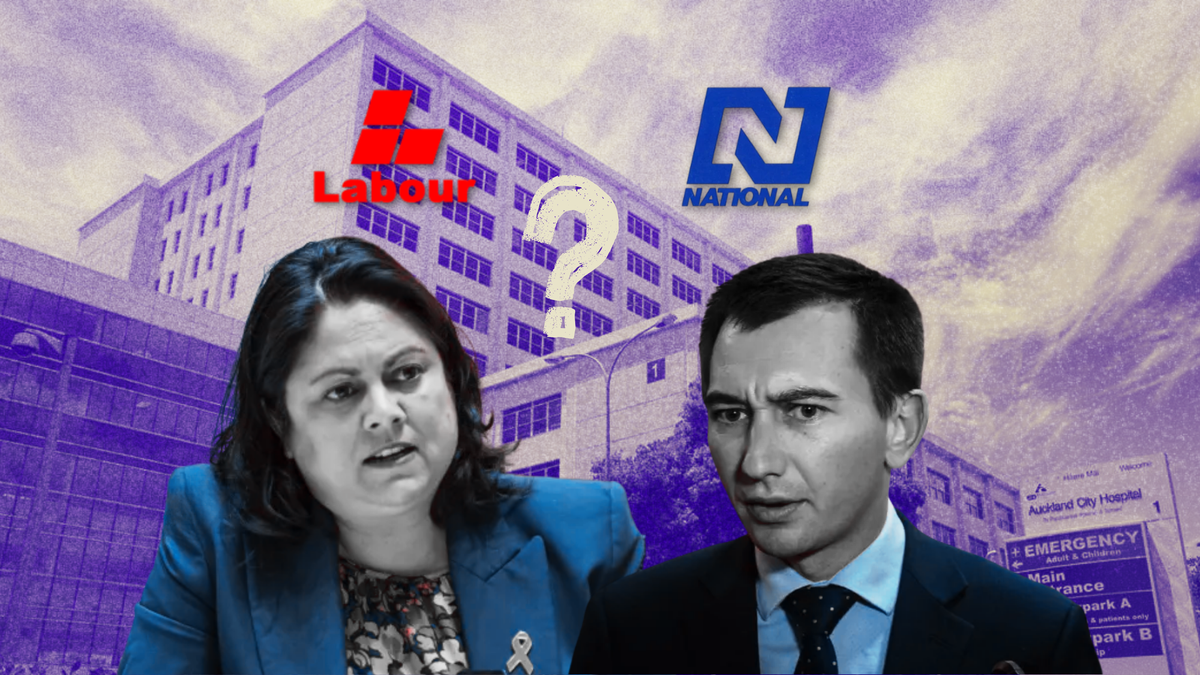
Read the transcript of the third episode of Public Interest's fortnightly current affairs show, Undercurrents.
This is an edited transcript of the conversation between Rob Campbell, the former chair of Te Whatu Ora, and Justine Sachs, a union organiser in the health sector, in conversation with Ollie Neas. You can view the full episode here.
Ollie
A recent editorial in the New Zealand Medical Journal described New Zealand's health system as being at an inflection point. Others have used the term “death spiral”. Rob, how would you describe the state of New Zealand's health system at the moment?
Rob
It's extremely stressed and inadequate and in danger of getting worse. The inflection scenario that was described, I think, is fair.
If I sound just a little hesitant, it's because I'm aware that, for people working within the system and people currently being treated within the system, too much negativity doesn't help their situation. So to me, there's got to be a balance in these discussions between honestly recognising the very real problems there are, while also recognising the tremendous work that is done within this health system under tremendous stress.
Ollie
Is it fair to say that the stress is getting more intense?
Rob
Yes, I think there is evidence of that. And it's not just within the health system. I think you have to start outside the health system and the observations that are being made that a lot of aspects of the health of our communities are deteriorating untouched by the health system.
So things like rheumatic fever and other experiences of ill health which are very dangerous and are being experienced by the poorest families — and the children in the poorest families in particular — who are simply not in contact with the health system at all. So much that is happening in our society, with the poverty that's being generated and the inequity that's being generated, is causing serious health problems.
So it starts there. Then when people do try to interact with the health system, there are these enormous issues of access for rural people, but also for people in cities simply not being able to access the system. There are cost issues that again impact most greatly on people on the lowest incomes.
And then there are performance issues within the system as well. Once you get in, and once you can afford to pay to get in if you can, then there are performance issues which are leading to waiting lists, treatment mistakes because of the pressure that people are under, all those sorts of things.
So whichever way you look at this health system, it is under enormous stress.
Ollie
Justine, you work as an organiser with people in the health system. What are you hearing from health workers about the day-to-day reality at the moment of working on the front lines?
Justine
I agree with Rob in the sense that you've got to thread a needle here in how we talk about the health system because there are amazing health workers across our public system who are doing wonderful frontline work. So when we talk about the issues in the health system, it's not to in any way undermine or denigrate their service.
I guess what I'd say I'm hearing from health workers is a sense of moral injury. That's the key theme that comes across. They want best practice. They want to provide the best care possible for communities, and they're not able to do that.
Not only is work severely stressful and there's an element of burnout from under-resourcing, but at the same time there's a moral injury in not having the resources to meet demand.
Ollie
Justine, what you're describing, we're seeing in the numbers, aren't we?
Surgery and specialist wait lists have increased fairly substantially in recent times. According to one report, more than 77,000 people are now waiting over four months to see a specialist. And in terms of the impact on emergency departments, the number of people reporting into ED has increased quite a lot over the last decade, leading to overcrowding in a number of cases.
I imagine the day-to-day impact of that on nurses and other frontline workers must be immense.
Justine
Look, the stress is immense. It really is. People know this, right? I don't think this is a secret, because anyone who has to go to an emergency department at the moment knows it's a horrific experience.
No one's saying you should be having a wonderful experience going into ED — you've probably got an emergency you need to be seen to — but waiting five to nine hours sometimes just to have a basic rudimentary evaluation, these are traumatic experiences for people. They leave feeling very angry about the state of our health system.
And you can imagine the people working in those conditions as well. As I said, there's that acute moral injury. And I think most of this stuff isn't helped by the fact that three hours away on a plane ride, you have one of the best places in the world to be a nurse.
Rob
The Australian system is doing to our system pretty much what our system does to the Tongan and Samoan health systems. We extract workers from them because of the same reasons that Australia extracts workers from us. And it goes on down the chain, probably somewhere else after that.
Ollie
Underpinning this is a huge amount of unmet need in the community. We're seeing significant increases in the number of people showing up to ED because clearly they haven't had their needs met elsewhere. But that flows through into people on waiting lists and non-acute hospital patients in hospitals.
Those people are then faced with very long waiting lists. And the options they're left with are very different depending on the position you're in. If you've got the money to do so, you have the option of going into the private system to get the care you might need faster. But if you don't have those resources, for most people that's not an option. So are we seeing the locking in of a two-tier system of this kind?
Rob
Well, there's no question that we have a two-tier health system.
One of the problems you have with these sorts of discussions is that, for around about half of New Zealanders, the health system works well. They live in a city, they have good salaries, they have a GP they're registered with, they carry health insurance, and if they have illness issues which are not terribly serious, they get them treated well and within their means and promptly. And if they have really serious issues, our public system does spring into action and does provide excellent care.
So you can talk to around about half the population who don't understand why we're even talking about this as a health system in crisis. They read the news headlines and things, but for them it doesn't seem to be that way. The other half of us feel it, experience it, know it.
And if that's not a two-tier system, I don't know what is.
It's been building up for decades. The root of this was probably set right back in 1938 when the public health system was established as part of the Social Security Act. Under pressure from the British Medical Association, which then represented the doctors, primary care was exempted from the public system and the GP structure was created as a private enterprise structure.
So even then we started to see these postcode lottery, two-tier system dynamics emerge. If we had opted at that time to have a genuine, fully funded public system that covered all health issues, including primary health, I think we would have evolved very differently.
But in the decades since then, with that little chink opened up in the health defence, the private part of it has grown. People with money and with access have been able to improve their situation, and it's been very hard for the rest of the community to improve ours because that just looks like a cost to the rest of them.
So yeah, it's a two-tier system.
Justine
Yeah, I completely agree with Rob.
Recently I was at the movies and there was this horrendous Southern Cross advert of people joyfully dancing around. At first I thought, “Is this an Auckland Council ad? What is this?”
It was an advert for health insurance. As the ad ends, it goes through all the people dancing and all the recent health interventions they've been able to have as a result of having health insurance — things like hip replacements. And that left an incredibly sour taste in my mouth.
The other thing I'd say is that every night I think about the fact that primary health and dental were exempt in the 1938 Social Security Act and I cry a little. Probably one of the worst mistakes we've ever made as a country.
Rob
Yeah, well, I think we would all recognise — those of us who are primarily concerned about the health sector — that we also have a two-tier education sector. We also have a two-tier housing sector. Wherever you look, we have at least two tiers. And some people end up on the wrong side of the tier system all the time.
Justine
Rob, are you trying to say that the history of all hitherto societies is the history of class struggle?
Rob
Well, I think you can certainly see recurrent themes.
Ollie
That gets us to the question of what is at the root of this. Clearly there's a funding issue here. To what extent is it just a funding issue versus something about the structure of the system?
Rob
Funding is a huge issue on its own, and New Zealand does not spend as much as we should, nor as much as some other comparable societies spend on health. So there certainly is a strong argument for simply more money to be spent on health.
How we spend it is, I think, an even bigger issue. How we allocate that money, the things that we prioritise to preserve and promote the health of our populations, is a big issue.
The most obvious one is that we vastly underspend on health prevention, both in terms of what it needs and in terms of what other comparable societies do.
A dollar spent on preventing ill health is a much more productive dollar than a dollar spent in the repair shop. Our health system — I like to describe it as a repair shop — is very necessary when you've been damaged, but it's not the answer to continually being damaged.
So that prevention aspect is vastly under-addressed in New Zealand, and that means we have to spend more down the track in primary care and then in secondary and other forms of acute care.
So how we spend is really very important, but both issues have to go together.
Justine
It's interesting because there are divergent views on health funding within the field of health economics.
The University of Auckland has done some analysis and, when you look at New Zealand's health spend compared to other comparable countries in the OECD, we spend less as a proportion of GDP. I think that's relevant. But I completely agree with Rob that it's also a matter of where we spend it.
I think one of the ways we're absolutely not served by short-term thinking in terms of the health system is that we're often spending short term to resolve short-term issues without thinking about longer-term prevention.
If you talk to any health worker at the moment, what they'll tell you is that people are coming into our hospitals sicker. They're coming in sicker because they're not able to access primary healthcare.
So our primary system is broken, and that's putting far more pressure on our hospitals.
We need to fund our hospitals properly and make sure we get resourcing right there, but you cannot do that in a silo. You need to look at primary health. You have to look at aged care as well.
If you fail to do that — if you just focus on rudimentary measurements to assess the health of our health system — you're not getting at the real issue.
So yes, I think it's fundamentally short-term thinking. You can address the cause or you can just address the really surface-level issues. There's some really fundamental long-term workforce and capacity planning that needs to happen that just isn't happening.
Rob
Earlier this year we formed an organisation, Kaitiaki Hauora, which combines the interests of a very large number of health organisations who all say different versions of the same thing about this.
When we worked with those people — all people with direct knowledge of the health system — we tried to identify the most important things to address.
We came up with three.
The first is funding. We simply do need to spend more on healthcare and spend it more wisely than we are now.
Some organisations like ASMS have done very good research on that. The New Zealand Nurses Organisation has produced very good material as well. At Kaitiaki Hauora we currently have a group of respected economists producing a paper that will underline this issue of funding.
But alongside that, you have to address the ongoing privatisation of key aspects of our health system and the way in which that is weakening the overall system.
We don't too much mind if some people want to get private care. Fine. But that's being achieved in such a way at the moment that it's weakening the public system.
And third, really critically important, is the need to address Māori health inequity.
The moment you start talking about these two-tier systems, you have to see that Māori health issues are very pressing and very inequitable. The answers to Māori health issues all lie within Hauora Māori — Māori health practices, Māori health procedures, Māori health organisations.
So you have to address that as well. You can't just say we're all patients who are all the same, because we're not all the same. We might aspire to be similar, but we're certainly not the same as things stand.
So what we're saying is you've got to think about this in three ways. But funding is fundamental.
Justine
Just as an example, and I think this is useful in understanding the way privatisation by stealth weakens our public health system: when you contract surgeries out to the private sector, they generally take the most profitable and easiest surgeries. The most acute and difficult surgeries remain in the public health system.
When you're developing your doctor workforce, you want doctors who are new to practice to build their capacity through straightforward surgeries first, before building toward more complex cases.
But when those simpler surgeries are in the private sector, you lose the ability to train people that way. So it weakens workforce development as well.
Ollie
It's a bit of a false solution, isn't it?
The notion that outsourcing is going to free up space in the public system maybe holds true if you've got a constant increase in medical staff, but if that's not the case then you're really just shifting resources from one pool to the other.
There seems to be a consensus in the international literature that increased privatisation and outsourcing in health systems is associated with higher costs overall, reduced equity, and negligible improvements in patient outcomes.
Rob
We've seen internal Health New Zealand documents acknowledging that the cost of doing operations currently contracted out to the private sector is higher in the private sector than in the public sector. That's simply an acknowledged fact.
They say they're doing it because of shortages of resources and space and all these other things, but they acknowledge that what they're doing is more expensive.
And Justine quite rightly makes the point that the private health sector is carried on the back of the public health sector. They don't exist in the form they currently do without a strong public health system.
Not only is the public system under stress, but the private health system in New Zealand and elsewhere is also under tremendous stress because their costs are escalating. Why? Because private interests are extracting more and more from them. Private equity businesses that own private hospitals are charging more and more. So they're under their own set of cost pressures.
But the important thing in New Zealand is that the private health sector depends on there being a strong public health sector as well. The underprivileged are piggybacking the privileged.
Justine
The private sector has profit there, right? There needs to be surplus, so of course there are going to be higher costs when you add profit into delivering health services.
And the idea that privatising the system would save money — look at the United States. Who spends the most on healthcare? The United States.
When you have a huge administrative system to assess people's eligibility, insurance dynamics, billing and all the rest, that's a massive cost. The United States spends more than any comparable country on health because it has a private system.
The reason we'd move toward a private system is not because it's more efficient or works better or delivers for patients. It's because of vested interests.
Health inflation is much higher than other forms of inflation. Costs are going up because every tier of the market is trying to extract as much value as possible. And the people who lose at the bottom of that are patients.
I think we should oppose privatisation on almost every level. It's more expensive, it doesn't deliver, it's bad for health workers and it's bad for patients. It's not something we want to see in New Zealand.
And when you look at the United States, it's a manifestly failed health system.
Rob
It's a great irony, isn't it, that the United States has the most expensive health system, the most privatised health system, and declining life expectancy.
Ollie
Rob, you mentioned the way in which the success of the private system is built on a stable and functioning public system. Do you think the private sector in New Zealand recognises that the public crisis is an issue for it, or is it blinded by the opportunity to expand demand for private medical care in New Zealand?
Rob
I think it recognises both and tries to maximise the opportunity and minimise the costs of it. It's what business does.
These are not silly people. They know that if we said to them, “Gosh, you guys have got a private system, that's excellent. Why don't you now go and train your doctors, train your nurses, provide the full tier of healthcare and hospital care that is needed, and fund it yourselves?” they would say, “No, we can't do that.”
They know very well that they depend on what the rest of us pay for to enable them to run their second tier.
At some stage, they're pretty happy when people campaign to spend more money on the health sector because they know a fair bit of that will flow to them. The bit they're not happy about is making sure the public part is getting a fair go, not as opposed to the private part.
Ollie
I'd like to spend a bit more time digging into how we've got to this point.
Rob, I'm glad you brought up the first Labour government and that fateful decision all those years ago not to bring GPs fully into a unified public health service. But it would be fair to say, wouldn't it, that for decades we had less of a two-tier system.
Like so many things, the 1980s and 90s brought significant changes to the health sector. We saw the introduction of greater fiscal restraint, a shift to a more market-oriented system in some ways, greater use of outsourcing, and the expansion of a more managerial approach to healthcare.
Some of the more hardline neoliberal aspects of that were wound back in the 2000s. But to what extent are the reforms that were brought in then behind the challenges we're facing today?
Rob
I think they're a critical component of the problems today.
The health system does have a bit of reorganisation fatigue. For a major public system like this, we did go through a lot of change.
First there was the idea that competition was going to be the answer and the Crown Health Enterprises were introduced. They were supposed to compete with one another and produce a more effective outcome. That didn't last very long. Getting out of the books of the Business Roundtable and into reality, it pretty quickly ran into a brick wall.
Then there was reorganisation around the district health boards. That system had some good elements in it. It was not as centralised as the system had been, so it was able to respond to different geographical and demographic pressures in different parts of the country.
It did have a democratic element in terms of elected people being on the boards of those organisations. I'm not going to over-emphasise that, but it did have a positive public element in the structure, which we don't have at all now, of course.
So there's been that gradual slide. And then, with the Pae Ora legislation and now the slippage back from it, that's a lot of structural change in a public sector organisation. I think the sheer effect of constant change has had a major effect too.
But the drift overall has been toward a much more commercial model of healthcare and health delivery.
We could well be on a track to a much more corporate form of healthcare if there isn't very strong resistance to what is happening at the present time, because the private sector will fill the gaps. They will fill them to their own satisfaction and it will be to the satisfaction of some parts of the community.
So we could well see a much greater corporatisation and privatisation of aspects of our health system. We'll still be paying for it. We'll just be getting it through a corporate structure and all of the differences that exist in the private enterprise world will apply to us.
I hate to say this, but we could be at an early stage of this rather than a late stage.
Ollie
You were talking before about this constant process of reform. The last five or six years have seen that quite intensely.
The last Labour government introduced what were probably the most significant health reforms in at least 20 years, or maybe 30 years even.
For listeners who are not across those reforms, what were the key aspects of that and what were they trying to achieve ultimately?
Rob
I think this is really important because those Pae Ora reforms are being badly misportrayed, and that's not helping people's understanding of the problems or the solutions.
The Pae Ora reforms placed equity issues at the heart of the public health services. They eliminated the old district health boards and the idea was to create a national platform so we had consistent, accurate data about what was happening in the health service, and financial management on a national basis, which had been absent from the health service.
That was the centralisation that had to happen. The interesting issue was that centralisation was so community organisations would be able to deliver on a solid foundation. It was not an end in itself. It was to centralise some things so that we could more effectively deliver at a local level.
The key elements at the local level, which have now been forgotten, included a structure called localities. These were not regions. They were community-based organisations that would define what their area needed in terms of healthcare services. They would draw up a locality plan and then monitor that whatever the health services were — public, private, any other way — that service was being developed.
That took some time to do, but it was a critical element.
In the same way, the Iwi Māori Partnership Boards were designed to specifically address Māori health equity, not just by creating greater strength in Māori health organisations, but also by monitoring the performance of Te Whatu Ora, Health New Zealand, so that it was developing on the equity objectives set out in the legislation.
The third element that was really important was the health charter, drawn up after extensive consultation with people within the health sector. It defined the principles according to which health services were going to be delivered. That covered not just workers and employers; it covered all the interests in the health sector.
So it was a set of agreed principles, now abandoned, that would be legislatively required to be followed by everyone from the minister down to wherever you would like to put it in the health sector.
I think that was a very bold plan. There were real problems with it, I've got to say, but in my opinion that was a guide to what the future of a health service could and should look like.
Some of the difficulties were that we had to inherit the administration and management of the old system, people who had been schooled in this corporate style of management, and many found it very hard to adapt.
There was an anti-union element, which I experienced strongly in Te Whatu Ora. The leadership at management level was strongly anti-union.
It was slow to allocate resources to Te Aka Whai Ora, which is now abolished as well. Te Aka Whai Ora was getting the Iwi Māori Partnership Boards together, just as Te Whatu Ora was getting the localities together.
Those plans were developed. They do exist. That work was happening, but it was being under-emphasised and under-funded.
What I think happened was that the government got a little bit scared of the implications of what it had enacted. When they saw what was happening, they were a little fearful that this was going further than they really wanted.
That was the essence of my argument with the previous Labour government. They kept telling me, “Rob, stop talking about equity. Rob, stop talking about public health measures. Rob, it's not the government's policy to restrict liquor outlets. No matter what our public health experts say, it's not our government's policy, so you can't advocate for it.”
So there was this resistance within it. And that went back to the fact that, for all the good principles, the primary development of the way it was going to operate was done by a contracted-out consultant process, with EY paid many millions of dollars to tell us how to run the system.
So: great system, set up sometimes in the wrong way, run sometimes by the wrong people, with a political leadership that didn't really want to go as far as it had gone in the Pae Ora legislation.
It has therefore been relatively easy for the current government to dismantle, as I kept telling the Labour Party at the time.
I'm not anti-Labour Party at all. I've been a long-standing Labour supporter. But as I was telling that government at the time, the problem is not that you don't have the courage of your convictions. It's that you actually don't have the convictions — that you really want to change this health system.
If we had pushed much harder, much quicker, much further with the Pae Ora legislation, we would not be in this situation today.
If we had had the time and effort, if we had strong Iwi Māori Partnership Boards and strong locality structures in place, they would be fiercely resisting what is happening now. It would be politically impossible to do.
But because that effort was constrained, it's been relatively easy to dismantle.
Ollie
That sounds symptomatic in some ways of some of the broader issues with the last Labour government: a tentativeness dragging on throughout its administration to the point where big, important changes were left late or implemented half-heartedly, such that they were very easy to undo when the government changed.
With health, this new government has undone many parts of Labour's changes. But have some aspects of Labour's reforms survived?
Rob
Yes, some aspects have survived, mainly the managerial parts.
They haven't re-established the district boards. They haven't re-established any of the democratic elements that were in that. No surprise there.
They've strengthened the centralised management control issues. They talk about devolution under this government, but if you contrast what I've just been talking about with what's happening now, all they've done is set up a totally managerial system with some delegations you would find in any corporation to enable spending down the line.
They call it devolution, but it doesn't devolve power. It just devolves control of some spending.
In the same way, the Iwi Māori Partnership Boards still exist. They are building in strength. I think they are a potential shining light in our health sector if they are not constrained.
If the government fulfilled its promise to do more and more funding through the Iwi Māori Partnership Boards, then I think that could happen. It hasn't happened yet, and whether it happens will depend on the strength of the people in those boards.
So I think the technical form of Pae Ora is still in place, but they have gutted the equity aspects and the genuine devolution aspects of it.
They have portrayed the previous endeavours as centralisation and themselves as devolving from that, when in fact exactly the opposite is the case.
Ollie
One of the more controversial aspects of this government's reforms has been the scrapping of Te Aka Whai Ora, the Māori Health Authority.
The government's justification was that it was a divisive structure and would mean care was based on race rather than need. Rob, what's your response to that justification?
Rob
It's simply not true. It's true that's the justification they used, but it is not true.
The health services being provided under the Hauora Māori framework were available to everyone. If you went into Hauora Māori health services, you would find Pākehā there as well as Māori. The critical thing was the style of care and the way care was delivered — not who was allowed to access it.
It's a total misrepresentation. It was never separatist. In fact, many Māori experience the current health system as highly separatist because they can't access it.
So it's no good telling people that the old system — which was bringing services to marae and communities — was separatist, while the system they can't access isn't. People can see through that very quickly.
Justine
I remember you telling us a story about a Pākehā man who was getting healthcare through a Hauora Māori provider and, when asked why he'd go there instead of another GP service, he said, “What other health service gives you a cup of tea and shows you manaakitanga when you walk through the door?” That really struck me.
Rob
Yeah, it was very real. I actually told the Waitangi Tribunal that I thought it would have been wiser to abolish Te Whatu Ora and keep Te Aka Whai Ora than the other way around.
Ollie
When we consider the push toward privatisation or outsourcing, do you see that as an ideological agenda from this government, or more just conservatism and drift?
Rob
I do quite like a good conspiracy theory, Ollie. So part of me thinks these guys have been plotting this for a while in back rooms. But honestly I think it's mainly a lack of imagination and courage.
They find it hard to imagine how a public system could work from their perspective. They see private enterprise as the answer to every problem. And that's a poverty of imagination.
Those of us campaigning for a stronger public system are not trying to abolish private dentists or GPs or pharmacists. There's room for private practitioners within a system run in the public interest. But these people seem to want to weaken every aspect of the public world and replace it with the private world.
The beauty of the Pae Ora legislation was that it understood health as something organic. Te Whatu Ora wasn't just a Māori name slapped on the front door. It reflected the idea that good health comes from weaving together all the various strands that make up a healthy community.
It's not just a Māori translation of Health New Zealand, which I think honestly this government probably thinks it was. It actually embodied the way that people were trying to think about the system as being something organic, operating in the public interest and drawing in all the various ways in which a healthy community could be created.
When you just drive a truck through that and say the only answer is privatisation, that's destructive and small-minded. So it could be a conspiracy. I suspect it's the latter really.
Ollie
I want to touch on targets for a second.
This has been a centrepiece of the government's messaging around health — shorter ED wait times, faster cancer treatment, reduced wait times for specialists and so on. On one level, that sounds reasonable. What are the issues with the emphasis on targets?
Justine
The resources aren't there. And the measurements don't necessarily reflect reality. Are wait lists decreasing because people are getting treatment, or because people are being removed from wait lists? Are discharge times improving because people are being properly cared for, or because they're being pushed out the door? I've got a little bit of frontline experience and I'll say that there's elements of that happening.
Here’s a more faithful light edit of that section, keeping much closer to the original wording and cadence while still cleaning obvious filler, syntax issues, and transcription glitches.
Rob
Of course you have to have some aims in any organisation or any system, and you do need to define what we are trying to achieve in the short term, the medium term, and the long term. You can use the term “targets” for your aims — preferably probably the short-term ones.
In itself, that's not exceptional. But this is running a public health service out of a textbook from some corporate business course in the 1960s. It's even out of date from the sort of source you might have thought it came from, because these are targets that are defined by a minister.
Justine
Man, Rob, that is a burn. That is a burn. That's one of the best insults I've ever heard.
Rob
Well, I'm afraid it's true. What we have here is targets for our health system determined by politicians. That's the exact opposite of what the Pae Ora legislation was supposed to be about. It was supposed to be about turning it on its head, not about having ministers say, “These are going to be the targets.”
So that's a fault in itself.
But in the corporate world, targeting is obviously still used for the reasons I described. You have to recognise that targets will skew things. The reason you have targets is that they affect the allocation of your resources.
Once you direct the allocation of your resources to one, two, three, four, five things, it means less resources are going somewhere else.
So I might say we want to target prevention and we'll spend there. That means we probably don't have as much to spend on some aspects of hospital care. And you say, “I'm prepared to do that because I know that if I prevent this happening, I won't need that.” There are timing issues and sequencing involved in all of that.
But this naive idea that you can just leave aside the political definition of the targets — that you can just have these simplistic targets and say “go and get those” — it is inevitable that, in going to get those, which Health New Zealand is loyally trying to do, you will not be doing other things that could well be far more valuable, or could be far more integrated with the longer-term objectives of the organisation.
And I think we're seeing that.
Targets are important tools in administration, but they have to be used carefully, they have to be chosen very carefully, and they have to have the support of the people within the system.
So we've ended up saying, “Here's a target. Bugger me, we actually don't have the resources to do that target, do we? I know — my friend runs a private hospital across the road. We could achieve our target by getting my friend at the private hospital across the road to do that.”
And in doing that, yes, I will weaken the public system. But do I really care about that? Answer: no.
I care about it, and I think the public care about it, but this is what happens when you have political control of health services.
And these are people who say they're not doing that, but everything you see is about centralising the political control of our health services and making decisions which are not driven by health, not driven by what we know works, but driven by what someone elsewhere thinks is important.
Ollie
What you're speaking to there touches on a concern that I've seen a number of people in the health system raise, which is that we need to, I suppose, 'depoliticise' health policy and funding in some ways.
I've heard people talk about shifting decisions to an independent body. Is that possible? In a sense, all questions of funding are political, aren't they? So what do we mean when we're talking about trying to depoliticise health funding? Is that a way of avoiding the central struggle here?
Rob
I think it's absolute bullshit.
If you are not going to be political about the health of your communities, what else are you going to have an argument about? What's more important than the health of your communities to have an argument about?
I think health is inherently political, and we're seeing that. We're seeing deteriorating health because of political decisions that are being taken. It's the most important political fight there is.
And anyone who says they want to depoliticise it is simply saying, “I would rather the power structures of health stay exactly as they are, thank you very much. Leave it alone.” And that can't happen, because if that happens, we know where we're heading.
Justine
It's a technocratic response to the health crisis that doesn't actually resolve any of the issues driving the health crisis. And I totally agree with Rob — health is inherently political.
When people say they don't want health to be political, I think they're saying they don't want health to be so tied to government PR or electoral cycles, and things like that. And I think that is prudent and fair enough.
But when we're talking about depoliticising it, or further entrenching the power of administrative and bureaucratic management of health, I think that is incredibly short-sighted and undemocratic.
I agree with Rob: rather than resolve the issues, what we're effectively talking about is a very top-down kind of health system that's managed according to the whims of the political class. We'd be entrenching that.
It's appealing on a very surface level, but when you think more deeply about it, I think that's a really dangerous solution to pose to the issues we have in our health system.
Ollie
If we look now to the response we're seeing from communities to this government's health reforms and to the health crisis more broadly, how would you describe where the movement is at? What kind of resistance and advocacy are you seeing in the community to turn this around?
Justine
I think you just have to look at polls to see that health is at the forefront of many people's minds.
In terms of opinion polls tracking the issues New Zealanders care about, health has never been higher. And I think there's a reason for that. People are feeling and sensing the strain on the health system. They're struggling to access healthcare.
So health is top of mind in terms of what New Zealanders care about, second only to cost of living. I think that speaks to a sense that our health system is in crisis and that there's a lot of unmet need.
In terms of the community response, I think you've seen — firstly, at a workforce level — unprecedented levels of industrial action in the health system.
I remember Lisa Owen interviewing Health NZ CEO Dale Bramley, and she asked him: “Dale, why is Health New Zealand at war with its workforce?” And he obviously struggled to answer that question. But I think that reflects how it feels on the ground, certainly.
There is a lot of resistance from the health workforce, and you've seen unprecedented levels of coordinated industrial action. Allied health, senior doctors, nurses — you've had very high levels of industrial action.
And then there are community responses coming through as well. Rob's work is part and parcel of those coalitions coming together to fight for our health system.
In West Auckland, Phil Twyford has campaigned primarily around understaffing at Waitākere Hospital. I think that again reflects that this is what people in the community are talking about. This is a response to deep concern.
So I think there's an unsettledness with what's going on in the health system at the moment and people's inability to access healthcare.
And I think it's going to be a major part of the election and election issues. I think you're going to see the public and the health workforce continue to agitate and advocate around it.
Rob
We know from a survey we’ve done at Kaitiaki Hauora through one of the major polling agencies that 85 percent of the New Zealand population supports spending more on health and strengthening the public health system.
I think people know that. The problem we have is people feeling disempowered, not feeling that they know how or what to do about it. That’s why I think the work of the unions is so important in this, and why I hate the way the media portray this resistance from the health sector unions as being mainly about pay.
In fact, it’s the opposite. Pay is a huge issue, but it has mainly been driven by concerns about safe staffing levels, conditions of work, and access to the health sector. So they’re carrying a burden in that respect which the system tries to twist away from: “No, it’s just about money.” But it clearly is not.
So they’re an important part of making people feel a bit empowered.
I believe the work being done by the Iwi Māori Partnership Boards, as I said, is a bit of a shining light, in the sense that among those communities it is developing a feeling of being potentially empowered by what they can do from a very disempowered situation.
Campaigns like the large petition developed by Patient Voice Aotearoa, Malcolm Mulholland and the group that he did that massive nationwide hīkoi with, and the work done by the Dental Care for All campaign going community to community around New Zealand, are trying to get people to feel that they can be empowered at that community level.
And it’s absolutely vital work. This is not something we can hand over to the politicians in Wellington to do. So there are good signs there, and we’ve just got to strengthen those elements of empowerment when people are feeling powerless.
I’m sure that if people can see the way to improve our public health system, there’s not a shadow of doubt in my mind that that is what the people want. It’s simply a matter of believing that they can get there and organising to get there.
Justine
I also think this government is particularly weak around that. The public don’t have confidence in their management of the health system.
They got in there and, obviously, they’ve done a lot of damage. We haven’t even mentioned the recruitment freeze they instituted across the health system. They paused safe staffing programmes; they tried to scrap safe staffing programmes.
I think the public are very aware. They’ve also gone through and further entrenched privatisation, tried to give ten-year contracts to private providers and all sorts of things. The public are very aware, and there’s an acute level of anger around that.
Ollie
What’s at stake here if we don’t get this right? What’s at stake if the community is not able to put sufficient political pressure on this government, or successive governments, to fix the problems our healthcare system faces?
Rob
Well, I think our health statistics will continue to deteriorate.
Statistics are one thing. The real-life consequences are very dire, both for people in the community without adequate resources and for the staff. The problems will escalate. The deficiencies in infrastructure, those costs will continue to grow, and eventually we’ll have an even bigger crisis that someone will have to deal with.
Now, my mind refuses to let me think that that will happen. I think people in our country are better than that.
There’s a saying that you can tell a country partly by what it does, but partly by what it tolerates. At the moment, we’re tolerating far too much ill health and far too much inequity in health. And I don’t think that tolerance can be stretched much further personally.
So I believe we will see, hopefully, a radical rollback of this stuff. But if it’s not a radical rollback, I think incrementally we will turn the tide on these things.
Which campaign will do it, I don’t know. Maybe it’s dental, maybe it’s public hospitals, maybe it’s something else. Don’t know. But you’ve got to have a belief that New Zealanders, that citizens of Aotearoa, are basically better than to tolerate this nonsense.
Justine
I see our public health system as a taonga. I think it’s a treasure, something to be protected and expanded.
As Rob talks about, I think there’s a huge swell of support and also a sense of what’s at stake. There is an element of this being an existential fight for the future of our public health system. We have to win it. We don’t really have a choice.
I like what Rob says: there’s a tolerance for these things, and I think we’re reaching the end of that tolerance. I think that’s true to an extent. I also think we can’t afford to lose, because that tolerance could potentially grow. So we need to continue and be on the front lines of that.
I see the public health system as one of the last bastions of our social democracy. So much of our social democracy has been eroded or taken away, and the public health system — things like libraries — stand as monuments to a very, very different vision of society, and the economy, from the one we have now.
And so I feel a great sense of duty and responsibility for us to protect it and to nurture it, because I think it does provide an alternative to the rest of the way our society is run.
I mean, the fact that we do have a public health system with thousands of health workers who every day work to meet people on the basis of need, not because they can afford it — that’s a really beautiful thing.
That’s a vision. That’s a very different vision of society to the one I think this government has.
There’s a larger struggle here over the social contract, and potentially for a new social contract. So I think we should think about it like that.